
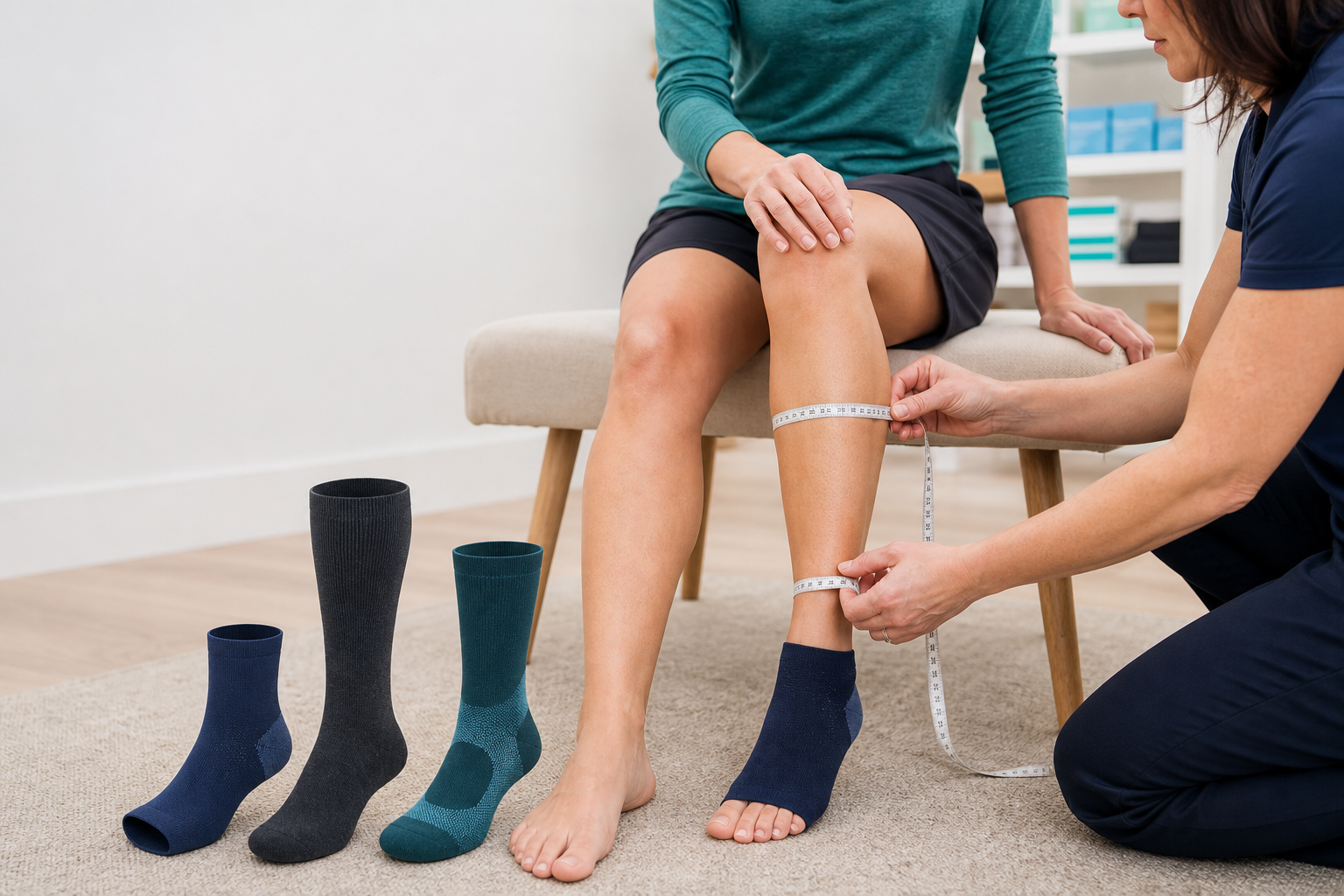
The short answer: choose compression socks by purpose, length, an exact size chart and a comfortable fit—not by the strongest-looking product name. Measure the ankle at its narrowest point and the calf at its fullest point, then follow the measurements requested on the current product page. A well-fitted sock should lie smooth, with no folds or rolled bands, while your toes remain their usual colour, warmth and sensation.
Compression products are not interchangeable with a medical prescription. If a clinician has prescribed compression, use the type, pressure, size and schedule they specified. If you have reduced sensation, known circulation problems, diabetes, wounds, skin infection, marked swelling, heart or kidney problems, or a recent procedure, ask a qualified clinician or pharmacist before choosing a consumer compression sock.
Start with the style, not the claim
| Style | What it covers | Useful comparison questions |
|---|---|---|
| Ankle or foot sleeve | Foot and ankle area | Does the heel align? Is the opening smooth rather than rolled? |
| Open-toe sock | Foot and lower leg with toes exposed | Does the toe opening sit flat without digging in? |
| Knee-high sock | Foot, ankle and calf to below the knee | Are ankle, calf and leg-length measurements required? |
| Athletic compression sock | Varies by product | What pressure, fabric and intended use does the live listing actually state? |
| Application aid | Helps with dressing rather than adding compression | Does it match the sock design and your mobility needs? |
Open-toe and closed-toe designs solve different preference and footwear questions; one is not automatically safer or more effective. Knee-high styles cover more of the calf, so correct calf and length measurements become especially important. An ankle sleeve covers less of the leg and should not be assumed to provide the same graduated compression as a clinically fitted stocking.
How to measure for compression socks
- Read the product chart first. Confirm which measurements and units it uses. Do not convert a usual shoe size into a compression size unless that chart specifically says to.
- Measure on bare skin. Keep the tape level and comfortably in contact without pulling it tight enough to indent the skin.
- Find the ankle. Measure around the narrowest point above the ankle bones.
- Find the calf. Measure around the fullest part while standing safely, or use the position directed by your fitter.
- Check length when requested. For knee-high products, this is commonly measured from the floor to the bend behind the knee, but the current chart controls.
- Check both legs. If they differ or fall across sizes, do not guess. Ask the seller or a healthcare professional which measurement should guide the choice.
For clinician-directed hosiery, follow the fitter’s timing. Some services measure or recommend application early in the day, before swelling increases. That timing is not a substitute for an individual assessment.
How a compression sock should feel
The fabric should be distributed evenly, the heel should sit in its intended pocket, and the upper edge should remain flat. Graduated medical hosiery is designed to provide more pressure lower on the leg and less higher up, but pressure levels vary. Never infer a pressure level from a title, colour, thickness or the word “compression.” Look for an explicit specification and professional direction where appropriate.
Compare the live details for the Ultra-V Striped Knee High Compression Socks with an open-toe option such as the Women’s Open Toe Plantar Pain Relief Compression Socks. The product names describe how the items are marketed; they do not prove that an item will relieve pain, treat plantar fasciitis or suit a particular medical condition.
Put them on without bunching or rolling
Start with dry skin and short, smooth nails. Turn the sock inside out to the heel, settle the toes and heel into position, then ease the fabric upward in small sections. Smooth it as you go. Do not pull only from the top edge, twist the leg, fold the cuff down or roll the band to make it shorter; concentrated bands can create unwanted pressure.
If hand strength, reach or mobility makes dressing difficult, a non-compression tool such as the Sock Assist may be worth comparing. Confirm that any aid is compatible with the specific sock and use it according to its instructions. Gloves designed for hosiery can also improve grip and help protect the knit from fingernails.
Safety check after application
After putting a sock on, check your toes and exposed skin. They should not become cold, pale, blue, purple or numb. Remove the sock and contact a healthcare professional promptly if you develop new pain, pins and needles, loss of sensation, worsening swelling, skin damage, unusual colour or a band that feels painfully tight. Do not reapply a clinically prescribed garment until the team responsible for your care advises you.
New one-sided leg swelling, warmth, redness or calf pain can be a sign of a blood clot and needs urgent medical assessment. Sudden shortness of breath, chest or upper-back pain, coughing blood, a very fast heartbeat or fainting can signal a pulmonary embolism; seek emergency help immediately. Compression socks are not a home test or treatment for those symptoms.
What to compare on a product page
- Stated compression: Is a pressure range actually listed, and is it appropriate for your intended use?
- Size inputs: Does the chart use ankle, calf, length, shoe size or a combination?
- Toe and heel construction: Will it work with your footwear and skin sensitivity?
- Fibre and care: Check allergies, wash temperature and drying restrictions.
- Return terms: Hosiery may have hygiene-related restrictions once opened or worn.
For a shorter design, the Pain Relief Compression Socks for Plantar Fasciitis can be compared for coverage, size information and current specifications. Again, the listing title is not medical evidence. Persistent heel or foot pain deserves assessment because several conditions can cause similar symptoms.
Wear, wash and replacement habits
Use the schedule provided by your clinician or the product instructions. Do not sleep in compression hosiery unless a healthcare professional has specifically told you to. Remove it at the recommended time, inspect the skin, and wash and dry according to the garment label. Heat, bleach, fabric softener or tumble drying may damage some elastic fibres, but care requirements differ by material.
Rotate pairs if you wear them regularly, and inspect the heel, toe, seams and upper band. Replace a sock when the fabric is damaged, stretched unevenly or no longer holds its intended shape. Never double two socks to improvise a stronger pressure.
Frequently asked questions
Should compression socks feel very tight?
They can feel snug, but painful tightness, numbness, cold toes, colour change or new swelling is not a normal “break-in” process. Remove the sock and seek advice.
Can I choose a size from my shoe size alone?
Only if the specific chart uses shoe size alone. Many knee-high designs also require ankle and calf measurements. Use the current chart rather than a remembered size from another brand.
Is open-toe better than closed-toe?
Neither is universally better. Consider footwear, toe sensitivity, warmth and the design recommended for your purpose. The opening must sit smooth and comfortable.
Can compression socks treat plantar fasciitis?
A product name is not proof of treatment. Compression may feel supportive to some wearers, but plantar heel pain has multiple causes and needs individual assessment when persistent, severe or limiting.
When should I ask a professional before buying?
Ask first if compression was medically prescribed, you have circulation or sensation concerns, diabetes, wounds, significant swelling, a diagnosed condition, or uncertainty about the correct pressure. A clinician can assess whether compression is appropriate and measure you properly.
Bottom line
A responsible choice begins with the purpose and an exact measurement, continues with smooth application, and includes a toe-and-skin check every time. Treat the current product specification—not its name—as the source for size, material and pressure, and involve a healthcare professional whenever symptoms or medical conditions make the decision uncertain.