
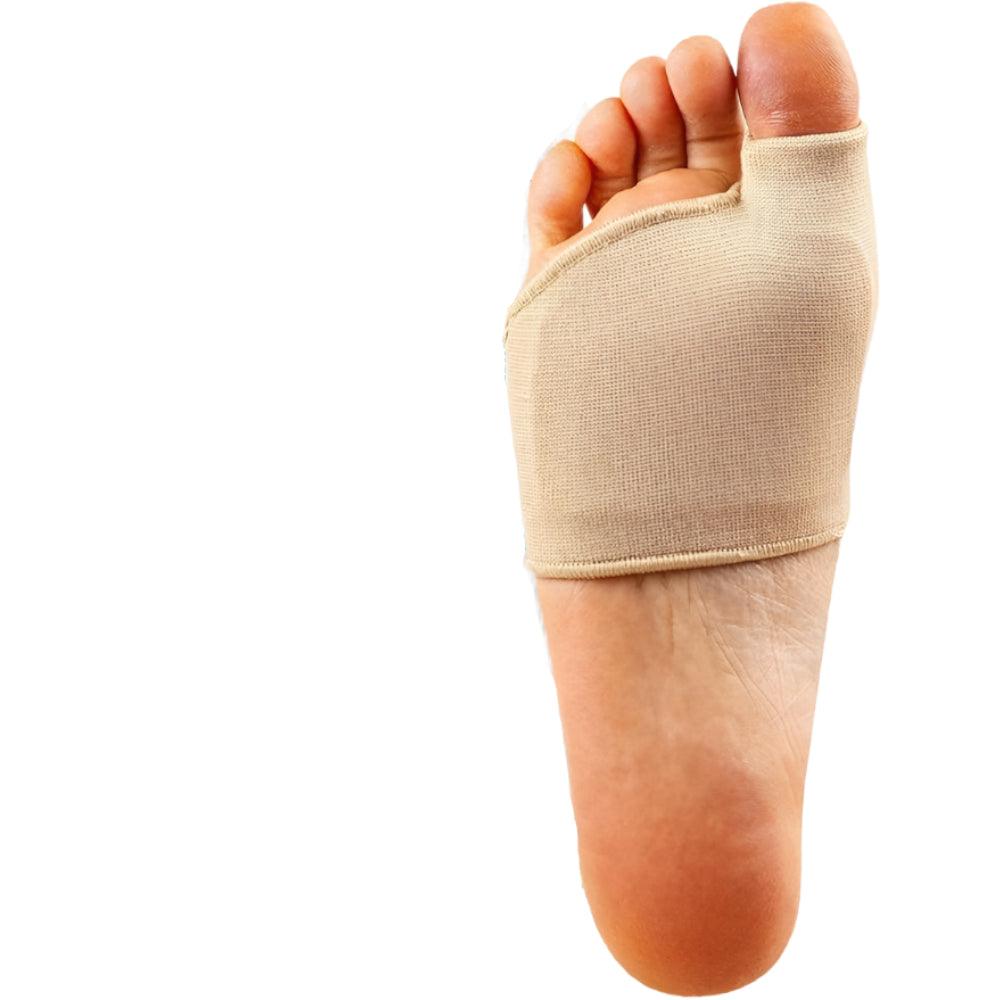
Quick answer: Open-toe compression socks stop short of the toes and leave them uncovered; closed-toe styles cover the whole foot. Our best sellers are all closed-toe, so if the toe area is your concern, the practical route is a seamless-toe design like our neuropathy socks or a targeted piece like the gel bunion relief sleeves.
Toe box design splits compression socks into two camps, and the right camp depends on why your toes are complaining in the first place. Here is the difference, when each style tends to appeal, and — honestly — what our own catalog does and does not offer for each toe problem.
The structural difference
A closed-toe compression sock covers the whole foot, toes included. An open-toe (toeless) style compresses the foot, ankle and often the calf but stops short of the toes, leaving them uncovered. The compression portion works the same way in both — the open toe box is the only structural change.
When each style tends to appeal
- Open-toe: people typically consider it for airflow around the toes, for wearing compression with sandals or open footwear, or because standard toe seams irritate them.
- Closed-toe: full coverage inside regular shoes, warmth, and no exposed toes — the default for work, sport and everyday wear.
An honest stock note
None of the top products in our order data is a dedicated open-toe compression sock — our best sellers are closed-toe. We said the same in our summer guide, and it still holds. What our catalog does offer is a set of closed-toe designs whose listings target the exact complaints that push people toward toeless styles.
Closed-toe answers to toe complaints
- Toe seams irritate you: the 3 Pairs Neuropathy Compression Socks ($19.99) are built around a seamless construction the listing says minimizes friction and irritation, designed with sensitive feet in mind.
- Blister-prone toes: the Cushioned Running Anti Blister 6 Pairs Socks ($23.99) feature a precision-stitched seamless toe the listing says eliminates irritation during extended wear.
- Sweaty or odor-prone toes: the Pain Relief Compression Socks for Plantar Fasciitis ($9.99–$24.99) place silver microbial fibers in the toe and heel, described as anti-bacterial and anti-odor, in a moisture-wicking fabric.
- Bunion pressure at the big toe: the Anatomical Gel Cushioned Foot Bunions Relief Socks ($14.99) take a different approach entirely — a sleeve with gel cushioning, even pressure distribution and a separate big-toe sleeve to prevent chafing, compatible with most shoe types per the listing.
How to decide
If you specifically want your toes uncovered — for sandals, say — you want a true open-toe style, which our best sellers currently do not include. If the real complaint is seams, friction, moisture or bunion pressure, the four closed-toe picks above address those complaints by design, per their listings. For toe conditions themselves, a healthcare professional is the right first stop, not a sock choice.
Frequently asked questions
What is the difference between open-toe and closed-toe compression socks?
Closed-toe socks cover the entire foot including the toes. Open-toe styles compress the foot and ankle but stop short of the toes, leaving them uncovered. The compression itself works the same way; only the toe box differs.
Does Plantar Socks sell open-toe compression socks?
Not among our current best sellers, which are all closed-toe. Several of them, though, are designed around toe comfort, with seamless constructions and moisture-wicking fabrics. Browse the storefront to see the latest range.
Which socks help if toe seams irritate me?
Two of our listings advertise seamless toe designs: the 3 Pairs Neuropathy Compression Socks, whose seamless construction is described as minimizing friction for sensitive feet, and the Cushioned Running Anti Blister 6 Pairs Socks with a precision-stitched seamless toe.
What do the bunion relief socks actually do?
Per the listing: gel cushioning technology supports the metatarsal area, pressure is distributed evenly with every step, and a separate big-toe sleeve prevents chafing. They come in sizes S, M and L, in black or beige, at $14.99, and fit most shoe types.
Are open-toe socks better for summer?
People often consider toeless styles in warm weather for airflow, but fabric matters as much as the toe box. Several of our closed-toe listings describe breathable, moisture-wicking fabric suited to heat, and our summer guide covers those picks in detail.
More sock guides
- Open-toe compression socks for summer comfort
- Neuropathy compression socks — a daily comfort guide
- Compression sock sizing guide — S/M, L/XL and S–XL explained
- Which compression socks do you need? A use-case chooser
This article is general information, not medical advice — talk to a healthcare professional about your specific needs.
Prices and specifications are current as of publication and may change. See the product page for the latest details.